I am traveling from Arua to Kampala. 498 km and 8 hours of bumpy road that connects the West areas of Uganda bordering Congo and South Sudan to Lake Victoria, crossing the Murchison Falls National Park, Uganda's largest national park with the world's most powerful waterfall (300 cubic meters of water per second). The landscape from the window of the minivan is incredible: antelopes, baboons, a few villages with children running and waving when they see us pass, women carrying baskets on their heads, and men chatting in the shade of a tree. Near Pakwach town, when there are still 5 hours of travel left, I see two elephants walking slowly along the road. I feel grateful that I am having this experience, I close my eyes, and by the time I wake up, I am already in the chaotic Kampala.
 |
| Elephants in Murchison Falls National Park |
My name is Florinda, I am 26 years old and until November I will be living in the capital of the Pearl of Africa. In this monthly blog, I will tell you about the activities I do as a European Aid Volunteer with Mondo (my sending organization) and my adjustment process to some of the cultural differences I experience.
I arrived in Uganda in late July and with my arrival, the rainy season began. This year slightly early. When I arrived at the office of the hosting organization (Uganda Pioneers' Association), Sarah, the organization's accountant, looked at me smiling and exclaimed: "Welcome! You brought the rain!". It took me a while to realize it was a compliment. In Italy (my home country) when they tell you that "you brought the rain”, it is a way of saying that you should have rested at home. Whereas in Uganda when it rains people feel blessed.
The meeting with the hosting organization, like many other appointments in the following weeks, started a few hours late, which reminded me that time is not perceived in all countries in the same way. As well as in Senegal (where I lived for one year), in Uganda the time system is polychromatic. People are not overly concerned with deadlines and punctuality, they perform and start different tasks and activities at once and they do not have a schedule for completing them: each task and activity will be completed in its own time (Duranti & Di Prata, 2009). I come from a monochromatic culture. For me, time is linear and perfectly divided into intervals, based on specific tasks. If the appointment is at 9 o'clock, I will arrive at 8:45. People who have a polychromatic conception of time, on the other hand, will probably arrive later and the appointment will start at 11. This is just because they are not ruled by time schedules. Moreover, in polychrome cultures, relationships with other people are the most important thing (Duranti & Di Prata, 2009). I remember someone in Senegal telling me that once, the director of a local organization showed up to a business meeting four hours late, justifying that he had met a woman on the way who needed to talk. Adjusting to this different conception of time is not easy; you have to be patient. Now, after one year in the African continent, I know that if I will probably have to wait, I can simply start another task.
 |
| TASK Art Centre where we had the DCT in Gulu |
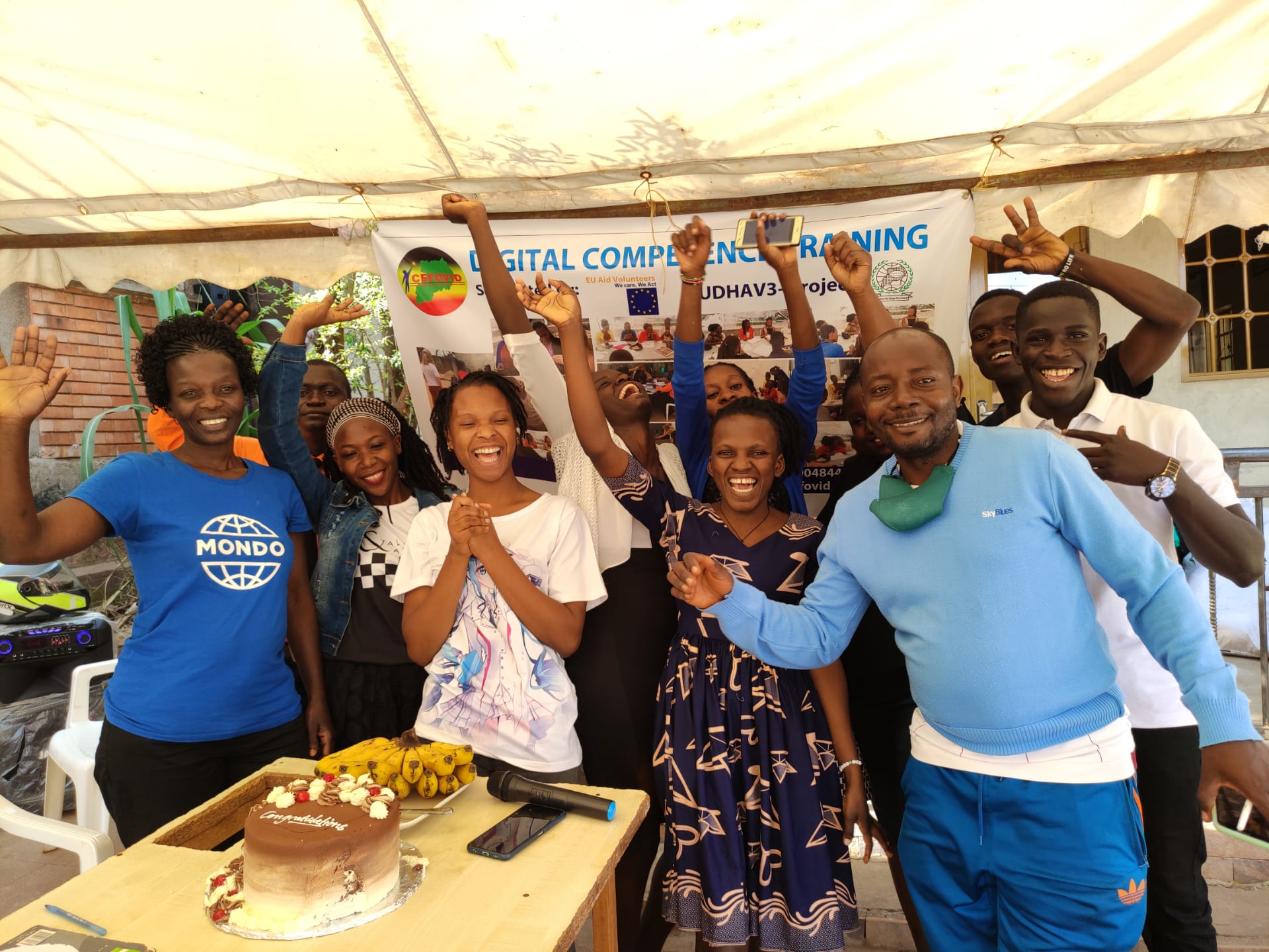
After the first weeks in Kampala, where I supported Mondo Team in readapting a Monitoring and Evaluation methodology for the Mondo Digital Competencies Training (DCT), I went to Gulu, in the Northern Region, to assist and support the Mondo Team in the implementation of the third and final session of the Digital Competences training. DCT is a program that Mondo has implemented in various countries including Uganda, aiming at different contexts and different targets, such as youth in vocational skills training centers operating in several refugee settlements and future primary teachers in Primary Teachers' Colleges (PTCs). The training is designed to teach how to use a digital device and mainly to increase employability skills with the proactive use of the Internet. In Gulu, our trainees were from the Uganda Pioneers Association Gulu Branch and after 3 intense days of lessons, they received their MDC certificate.
 |
| DCT young graduate |
 |
| Millet beer |
 |
| A map of Ugandan Ethnic Groups in a Primary Teachers' Colleges |
 |
| M&E qualitative data collection |
 |
| Sipi Falls |
We will catch up next month! Tula bagane (See you in Luganda)!
 |
| Students in Amuno Library |
1. Duranti, G., & Di Prata, O. 2009. Everything is about Time: Does it Have the Same Meaning All Over the World?. Project Management Institute. https://www.pmi.org/learning/library/everything-time-monochronism-polychronism-orientation-6902